

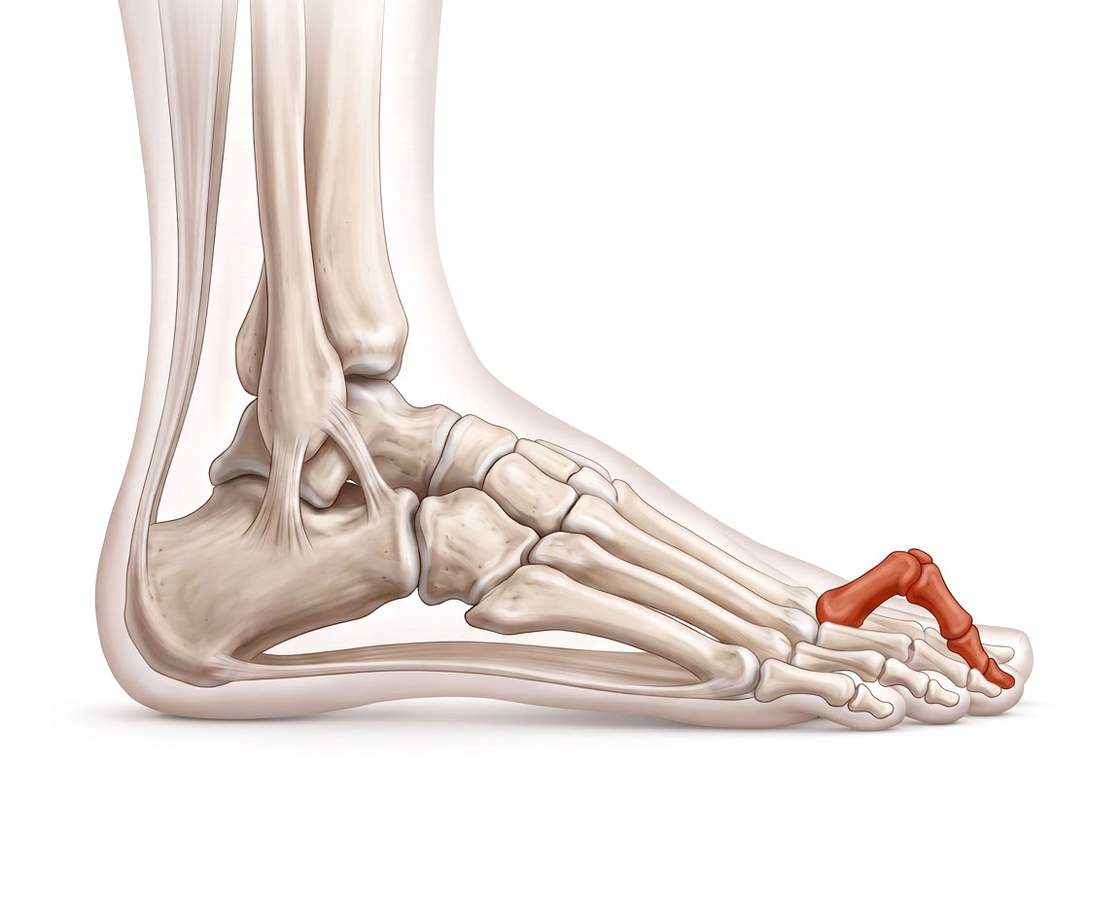
Hammertoe Treatment in Fairfax, VA
A toe that bends down at the middle joint and rubs in shoes, treated with padding, footwear changes, and corrective surgery when it becomes rigid or painful.
Overview
A hammertoe is a bend at the middle joint of one of the smaller toes, so the toe points down instead of lying flat. It develops when the muscles and tendons that balance the toe become uneven, and it most often affects the second toe. Early on the toe is flexible and can be straightened by hand. Over time it stiffens into a fixed position, and that is when shoes become a daily problem.
Symptoms
- A toe bent at the middle joint
- A corn on top of the bent joint or at the tip of the toe from rubbing
- Pain in closed shoes
- Redness or swelling over the joint
- A toe that is hard to straighten
- Pain under the ball of the foot
Causes and risk factors
- Shoes that are too short or narrow, which hold the toe bent
- A bunion crowding the second toe
- A second toe that is longer than the big toe
- Flat feet or high arches
- Nerve conditions and diabetes, which can weaken the small muscles of the foot
- Prior toe injury
Diagnosis
We check whether the toe is still flexible or has become rigid, look at the corns and pressure points, and examine the rest of the foot for a bunion or alignment problem that may be driving it. X-rays show the joint and help plan surgery when it is needed.
Treatment
- Conservative: shoes with a deep, wide toe box, corn pads, toe sleeves, and splints or taping for flexible hammertoes
- Orthotics: custom orthotics to correct the mechanics that overload the toe
- Corn and callus care: in-office trimming for comfort
- Surgery: for rigid or painful hammertoes, releasing or lengthening the tight tendon and realigning the joint, often through a minimally invasive incision; a bunion is corrected at the same time when it is the cause
When to see us
Book a visit at our Fairfax office if a bent toe is rubbing or painful in shoes, a corn keeps coming back, or the toe is getting harder to straighten. Flexible hammertoes are easier to manage than rigid ones. If you have diabetes, any sore on a hammertoe should be seen promptly.
Our approach
Dr. Andrew Falco and Dr. Shyaun Rafii look for the cause of the hammertoe, usually footwear, a bunion, or foot mechanics, before treating the toe itself. Most patients stay comfortable with shoe changes and padding. When surgery is the right step, we use the least invasive technique that will hold the correction.
Frequently asked questions
Will a hammertoe straighten on its own?
No. A flexible hammertoe can be kept comfortable and slowed down, but it does not go back to straight without surgery.
Is hammertoe surgery a big procedure?
It is an outpatient procedure, usually under local anesthesia with sedation. Recovery depends on the technique: after a joint arthroplasty, most patients are back in regular shoes once the skin has healed and the sutures are out, at about two weeks. When the joint is fused, the toe is protected longer while the bone heals.
Why do I also have a bunion?
They often go together. A bunion pushes the big toe into the second toe, which forces it to bend. Correcting both at once gives the best result.